Have you ever wondered about the unseen world that exists beyond our eyes? This secret is effectively encapsulated in Islam. In this write up I will discuss “Islamic View of Angels“. The belief in angels is not optional but a necessary tenet of faith for all Muslims. Believers in the existence of God cannot recognize this without believing that they are unfinished. Angels are created from light without any of the flaws that humans have – hunger, pride or laziness. Only they never trespass against Allah as men do. It is their only purpose that they completely obey Him in absolute sincerity, and with complete perfection.
In Islam, angels are not mere symbolic representations but actual beings. They are actual beings that act as messengers, guardians and agents of Allah. The Quran and the Hadith both describe them in detail, as a reminder to us that the universe is surely not limited to what we can feel or see. Angels release revelation, lead believers and are instrumental throughout our lives.
For a person of faith, to comprehending angels is to believe vertically and strengthen the heart. It is comforting to know that Allah has appointed noble beings to record deeds, protect humans, and seek forgiveness for the faithful. Similarly, their existence reminds us of responsibility towards the Judgement Day. The study of angels also inculcates the virtue of obeying, humility and continuous servitude to Allah among Muslims and for them this belief offers a real source of spiritual strength and hope.
The creation of the angels is a distinctive matter in the Islamic creed. Unlike humans, who are made from clay and jinn, who are made from smokeless fire, angels are created from the light (nur). This renders them a people apart and alone in the creation of Allah. Their Existence Indicates the Greatness of Allah’s Power in Creating Variable Species Having Different Works!
The angels are sinless entities who exist solely to serve Allah. They do not have any desires, hunger, or fatigue. Their formulation brings out the concept of total submission and complete obedience to the Creator. This is one of several characteristics that make angels different from human beings and jinn.
The Prophet Muhammad ﷺ described their source in a Hadith narrated by Aisha (RA):
عَنْ عَائِشَةَ رَضِيَ اللَّهُ عَنْهَا قَالَتْ قَالَ رَسُولُ اللَّهِ ﷺ
(صحيح مسلم) «خُلِقَتِ الْمَلَائِكَةُ مِنْ نُورٍ، وَخُلِقَ الْجَانُّ مِنْ مَارِجٍ مِنْ نَارٍ، وَخُلِقَ آدَمُ مِمَّا وُصِفَ لَكُمْ»
“The angels were created from light, and the jinn were created from (the) smokeless flame of fire, and Adam was created from that which you have been told (described to you); they are all valid creations.”

Their submission and obedience to Allah are also stressed in the Quran.
(66:6 التحريم) لَا يَعْصُونَ اللَّهَ مَا أَمَرَهُمْ وَيَفْعَلُونَ مَا يُؤْمَرُونَ
“They do not disobey Allah in what He commands them and do as they are commanded.”
This proves that angels are a unique creation and by nature of their creation, they exist on purity, loyalty and obedience to Allah the Almighty.
The Belief in Angels (Malaikah) as a Component of Faith (Iman)
The belief in angels is part of Islamic faith. A person’s Iman is not considered complete without it. Furthermore, it is one of the six pillars of faith every Muslim must believe in. To believe in Allah, his angels, his revealed books, his messengers, the last day, and divine decree
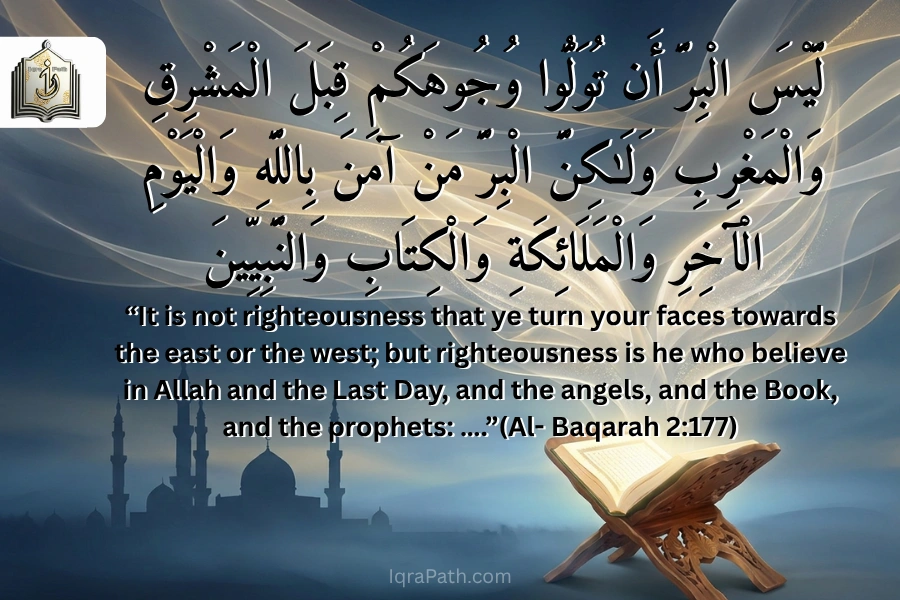
The purpose of believing in angels is directly mentioned in the Quran:
لَّيْسَ الْبِرَّ أَن تُوَلُّوا وُجُوهَكُمْ قِبَلَ الْمَشْرِقِ وَالْمَغْرِبِ وَلَـٰكِنَّ الْبِرَّ مَنْ آمَنَ بِاللَّهِ وَالْيَوْمِ الْآخِرِ وَالْمَلَائِكَةِ وَالْكِتَابِ وَالنَّبِيِّينَ
“It is not righteousness that ye turn your faces towards the east or the west; but righteousness is he who believe in Allah and the Last Day, and the angels, and the Book, and the prophets: ….”(Al- Baqarah 2:177)
Another verse confirms the seriousness of denying angels:
وَمَن يَكْفُرْ بِاللَّهِ وَمَلَائِكَتِهِ وَكُتُبِهِ وَرُسُلِهِ وَالْيَوْمِ الْآخِرِ فَقَدْ ضَلَّ ضَلَالًا بَعِيدًا
” For whosoever is an enemy to Allah, His angels, His books, His messengers and the Last Day; verily God is an enemy to those who are infidels.”
These verses are evidence that the belief in angels is not to be taken as a matter of choice. It is a central tenet of the Muslim faith. No one can be a true believer without it.
The six articles of faith to be precise which are also mentioned by the Prophet Muhammad ﷺ in the well known Hadith Jibreel when Jibreel approached him and asked him about Iman? The Prophet replied: “To believe in Allah, His angels, His books, His messengers, The Last Day and to believe that the decree both good and bad is from Allah.”
Therefore, having the belief in angels, a mu’min becomes more connected with Allah, is reminded that his actions are being constantly recorded and kept by Him and also it takes part in making his Iman true.
Attributes of Angels
The Quran and Hadith mention many characteristics of angels that distinguish them from human beings and jinn. These features indicate their purity, submissive servitude and continuous subjection to ALLAH. With knowledge of these attributes, Muslims can bring their hearts closer to faith and see the magnificence of Allah’s creations.
Complete Obedience

Angels never disobey Allah. And he does not issue commands with any other intention except for them to be obeyed.
(التحريم 66:6) لا يعصون الله ما أمرهم ويفعلون ما يؤمرون
“They do not disobey Allah in what He orders them, and carry out what they are ordered.”
Pure and Sinless
Angels cannot sin, as can humans and jinn. They don’t experience desire or hunger, so they never grow tired. And they are ever in (useful) servitude to God.
Strength and Power

Angels are strong by nature. As an instance, the Prophet Muhammad ﷺ spoke of Angel Jibreel as having 600 wings that cover the entire horizon.
رَأَيْتُ جِبْرِيلَ لَهُ سِتُّمِائَةِ جَنَاحٍ
“I saw Jibreel with six hundred wings.”(صحيح البخاري)
Ability to Take Forms

Although we cannot see angels in their true form, they can change shape. Jibreel manifested himself to Maryam as a man:
فَتَمَثَّلَ لَهَا بَشَرًا سَوِيًّا
“To her, he came as a shapely man.”(مريم 19:17)
Constant Worship

The Quran conveys the information that angels never grow weary or impatient from extolling Allah:
يُسَبِّحُونَ اللَّيْلَ وَالنَّهَارَ لَا يَفْتُرُونَ
“They celebrate His praises night and day, never tiring.”(الأنبياء 21:20)
From these attributes, it is evident that angels don’t have the same qualities as other creatures. They constantly glorify Allah, and by their example call the believers to appreciate the glory of Allah’s control over all things.
Major Angels in Islam
According to Islamic belief, some angels have been given a special role to mention for importance in the system. These are angels that Muslims are familiar with because of their important tasks.
- Angel Jibreel (Gabriel): He is also referred to as the messenger of revelation who delivers Allah’s words directly to the prophets. The job he had was to be the channel between God’s message to his Prophets.
- Angel Mikaeel (Michael): He is responsible for bringing sustenance, such as rainfall, and ensuring the distribution of provisions to creation.
- Angel Israfeel (Raphael): His role is to blow the horn on Judgment Day that brings an end to this world and the start of a new one.
- Angel Izraeel (Malak al-Mawt): Taking the souls of men when it’s ordered.
- Kiraman Katibeen: These are two angels for every human bead. One, they say, writes our merits and the other inscribes our failings.
- Munkar and Nakeer: These are the two angels who come to the grave to question the deceased. Their role is to test the faith of a person after death. They ask three questions:
- Who is your Lord?
- What is your religion?
- A third question is asked by showing the blessed face of the Prophet Muhammad (peace be upon him), and the person is asked: “What did you used to say about this personality during your life in the world?”
A believer will answer with firmness and peace, while a disbeliever or hypocrite will be unable to respond correctly.
All of these angels carry out the command of Allah with perfect obedience. They never tarry nor do they ever fail to perform their duties, but obey Allah perfectly, showing the ideal discipline of Allah’s creation.
Nature and Characteristics of Angels
According to Islam, angels are amazing beings made by God from light. They are unlike humans and jinn, because they don’t eat, drink or sleep. The angels always obey Allah, disobeying no command He gives. They have different forms and can take shapes when ordered by Allah, as when Angel Jibreel came to Maryam (AS) in the shape of a man. Angels are mentioned in the Quran to have wings: “[Angels] messengers with wings, two or three or four” (Fatir 35:1). This reveals aspects of their singular body characteristics that human beings are not capable of understanding. Angels are countless in number. Each angel is charged with a particular task; for example, recording human deeds, guarding humans, or directing natural phenomena by the will of Allah. Free from wants and sin, they are devoted servants of Allah. They have no option, unlike us, but to obey Allah. And their deed is to bow themselves, and to humble themselves before their Lord, in all faith and obedience.
Angels in Islam: Myths vs Reality
There are several misunderstandings about angels, and one of the most common is the belief that angels are female. This idea has no basis in Islam. Angels are not male or female, since they are created from light and exist beyond human qualities. They do not marry, eat, drink, or have physical desires. Their entire purpose is to worship Allah and carry out the tasks that He assigns to them.
Another misbelief is that angels know the unseen. The Quran instructs that none but Allah knows the unseen completely: “He alone has knowledge of the unseen and He does not disclose His unseen to anyone except to a messenger whom He chooses. (Al-Jinn, 72:26-27). Only Allah teaches the angels. In the narratives of Adam (AS), when Allah asked the angels about names, they said: “Glory be to You! We have no knowledge except what You taught”. That shows their knowledge is limited, as it also comes from Allah.
Another source of confusion can be found by comparing angels and jinn. Angels are created from light. Jinn are formed from smokeless fire (Sahih Muslim). Angels are always obedient. They cannot disobey Allah. Jinn, by contrast, are volitional beings. They can obey or disobey, as do people. The Shaytan himself was a Jinn who refused to obey Allah. That’s what makes angels and jinn so very different.
Stories and Incidents Involving Angels
Angels in Islam play a critical and necessary role, performing many tasks on behalf of God. The Quran is the central reference of the Islamic faith and the fundamental source of Islamic teaching and law. One among the ay angels is Jibreel (Gabriel). He was the angel to whom revelation was sent down to Prophets. It is this word that was revealed to Prophet Muhammad (peace be on him). Had he not played his inspiring role, the message of Allah would have never reached humankind in a similar way. That places Jibreel at the very heart of preserving divine guidance.
Another strong moment can be cited during the Battle of Badr. The Muslims were small in number and weak against their enemies. At that time Allah sent down angels with His help. The Quran relates that, during the Battle of Badr, Allah sent thousands of angels in ranks to support the Muslims. These angels supported the Muslims, struck fear in the hearts of disbelievers and contributed to the victory of Muslims on Allah’s orders. This divine succor encouraged the Muslims and helped them win. The event illustrates the role of angels in the making of history under Allah’s direction.
Similarly, mention is made of the Angels at death as well. To the faithful, angels are bringers of comfort and glad tidings. They give the good news of Paradise to the pious and drive away their fear. These are circumstances that display God’s mercy, when angels bridge the gap from this life to the one beyond for the believer.
Then there is the story of Prophet Ibrahim (AS). Angels appeared to him in human form, and bore the good tidings of a son, though he was old. Then the same angels told about the punishment for the community of Lut (AS). This does show how angels can be messengers conveying good tidings and bad.
These are the stories about angels that we need to tell, because angels aren’t faraway beings. Active warriors for Allah, they bring the revelation, defend the believers, and execute the judgments of God. The very fact that they are a part of the lives of Prophets and men of faith exemplifies how important they are in alam-e-ghaib.
FAQ’s
What does Islam say about angels?
Who are the 4 main angels in Islam?
Jibreel (Gabriel): The Archangel responsible for delivering revelation (wahy) from Allah to the Prophets.
Mikail (Michael): The angel responsible for providing nourishment, managing rain, and overseeing the natural world.
Israfil: The angel who will blow the trumpet to signal the Day of Judgment.
Malakul Mawt (Azrael): The Angel of Death, tasked with taking the souls of living beings when their time on earth is complete.
How are angels described in the Quran?
“Praise be to Allah… who made the angels messengers having wings, two or three or four…”
They are also described as being capable of taking human form when appearing before people, as Jibreel did when visiting Maryam (Mary) or the Prophet Muhammad.
Who is Allah’s favorite angel?
Can I name my child Jibreel?
Conclusion
This article also discussed the Islamic view of angels. We examined their origin, nature and role. Angels are used to bring revelation, they protect people, and write down all human actions. We also refuted some misconceptions, like the absurd belief in the gender of angels, or that they “possess knowledge of the unseen.” Their distinction from the jinn was also clarified. It is tales such as their contribution to the Battle of Badr, their presence at visits to the Prophet and assistance as believers that let us know how significant a legacy they left in Islam.
The belief in the existence of angels is a fundamental part of Iman. It is a reminder to us that there’s always an oversight, something or someone noting everything you do, and accountability is indeed real. Angel-driven obedience encourages Muslims to be disciplined and sincere in their living. They do not disobey Allah, and their precedent drives the believers to keep themselves humble and clean.
The education about the angels elevates faith in and confidence in Allah’s power and mercy. It gives a Muslim certainty that assistance from Allah is available everywhere and makes his heart accessible to the unseen world. The certainty of the reality of angels creates hope, action and devotion in the lives of Muslims as well as encourages them to adopt a life of worship and goodness.