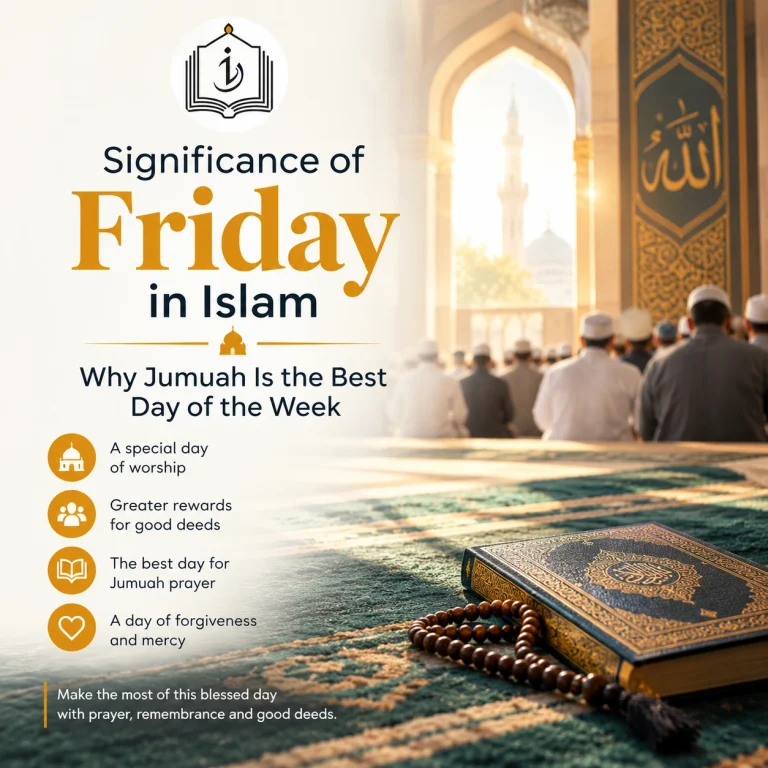
Reciting Surah Al-Kahf on Friday is a cherished weekly practice among Muslims worldwide. This beautiful chapter of the Holy Quran offers profound lessons about faith, patience, wealth, knowledge, and reliance on Allah. More importantly, Islamic narrations describe special virtues associated with reading Surah Al-Kahf on Friday.

But what are the benefits of reciting Surah Al-Kahf on Friday according to authentic hadith? Does it provide protection from Dajjal? What is the best time to read it? And is the famous hadith about receiving light between two Fridays authentic?
These are important questions for Muslims who want to follow the Sunnah with confidence.
Quick Answer: Reciting Surah Al-Kahf on Friday is recommended by many Islamic scholars based on hadith narrations describing a special light extending between two Fridays. This narration has been graded hasan (good) or sahih (authentic) by recognized hadith scholars. Separately, Sahih Muslim 809a establishes that memorizing the first ten verses of Surah Al-Kahf provides protection from the Dajjal. Muslims may recite the surah from Thursday sunset until Friday sunset.
This comprehensive guide explores the authentic evidence, spiritual significance, practical guidance, and frequently asked questions surrounding this blessed weekly recitation.
What Is Surah Al-Kahf?
Surah Al-Kahf, meaning “The Cave,” is the 18th chapter of the Holy Quran. It contains 110 verses and was revealed in Makkah.
The surah addresses important aspects of human life, including religious persecution, attachment to worldly possessions, the limitations of human knowledge, and the responsible use of power.
Its teachings encourage believers to remain steadfast in their faith while facing challenges.
Surah Al-Kahf contains four well-known narratives:
- The People of the Cave: Young believers who sought Allah’s protection to preserve their faith.
- The Owner of the Two Gardens: A lesson about wealth, gratitude, and the temporary nature of worldly success.
- Prophet Musa and Al-Khidr: An account highlighting patience, humility, and the limits of human understanding.
- Dhul-Qarnayn: A powerful ruler who used his authority responsibly and acknowledged Allah’s blessings.
Together, these narratives encourage Muslims to face life’s trials through sincere belief, patience, humility, and righteous actions.
Reading Surah Al-Kahf every Friday creates an opportunity to reflect on these lessons regularly.
Authentic Hadith About Reciting Surah Al-Kahf on Friday
One of the main reasons Muslims recite Surah Al-Kahf on Fridays is the hadith describing a special light between two consecutive Fridays.
Hadith 1: Light Between Two Fridays
Abu Sa’id Al-Khudri (may Allah be pleased with him) reported a narration attributed to Prophet Muhammad (peace and blessings be upon him):
“Whoever reads Surah Al-Kahf on the day of Jumu’ah, a light will shine for him between the two Fridays.”
References:
- Al-Hakim, Al-Mustadrak
- Al-Bayhaqi, Al-Sunan Al-Kubra
- Mishkat Al-Masabih, Hadith 2175
- Sahih Al-Jami, Hadith 6470
Hadith scholars have discussed the transmission and grading of this narration.
Ibn Hajar described it as hasan, while Sheikh Al-Albani authenticated the report in Sahih Al-Jami. The version in Mishkat Al-Masabih is also listed with a hasan grading attributed to Al-Albani.
Some transmission details remain subjects of scholarly discussion, but numerous scholars accept the narration as evidence supporting Friday recitation.
What does the promised light mean?
Islamic scholars discuss this light as a special reward and blessing granted by Allah. It is commonly understood in connection with divine guidance and spiritual illumination.
The narration itself does not provide a detailed explanation of how this light appears or operates.
Therefore, Muslims should affirm the reported virtue without inventing specific promises about physical brightness, financial success, or guaranteed worldly outcomes.
The important message is that regularly engaging with Allah’s revelation is a spiritually valuable act of worship.
Hadith 2: Light Extending Toward the Kaaba
Another narration attributed to Abu Sa’id Al-Khudri states that whoever reads Surah Al-Kahf on the night of Friday will receive light extending between the person and the Ancient House, meaning the Kaaba.
Reference: Sunan Al-Darimi, commonly cited as Hadith 3407, with numbering varying between editions.
This narration appears as a statement of the Companion Abu Sa’id Al-Khudri, with a chain authenticated by hadith specialists.
Related versions are also transmitted as prophetic reports.
The distinction between a Companion’s statement and a directly attributed prophetic statement matters in hadith scholarship.
Nevertheless, the narration contributes to the scholarly discussion supporting the virtue of reciting Surah Al-Kahf during Friday and its preceding night.
7 Benefits of Reciting Surah Al-Kahf on Friday
The benefits of Surah Al-Kahf include explicitly narrated rewards and spiritual lessons derived from its Quranic teachings. These two categories should not be confused.
1. Receiving Light Between Two Fridays
The best-known Friday-specific virtue is the promised light described in the narration reported by Abu Sa’id Al-Khudri.
The hadith associates reading Surah Al-Kahf on Friday with a reward extending until the following Friday.
For believers, this is a powerful motivation to maintain a consistent weekly relationship with the Quran.
Rather than treating the recitation as a mechanical ritual, Muslims can approach it with sincerity, reflection, and a desire to strengthen their connection with Allah.
2. Protection Against the Trial of Dajjal
One of the strongest authentic narrations concerning Surah Al-Kahf appears in Sahih Muslim.
Abu Darda reported that Prophet Muhammad (peace be upon him) said:
“If anyone learns by heart the first ten verses of the Surah al-Kahf, he will be protected from the Dajjal.”
Reference: Sahih Muslim 809a.
This hadith is particularly significant because it appears in one of the most respected authentic hadith collections.
The Dajjal, also known as the False Messiah, is associated with an immense trial before the Day of Judgment.
The narration specifically mentions memorizing the first ten verses.
Another wording in Sahih Muslim refers to the last ten verses.
Importantly, protection from Dajjal is a virtue connected to these verses and is not restricted to reciting them on Friday.
Muslims can benefit by memorizing the opening verses, reviewing their meanings, and incorporating them into their regular Quran study.
3. Strengthening Faith During Difficult Times
Surah Al-Kahf opens with praise of Allah and emphasizes the reliability of divine revelation.
Its account of the People of the Cave demonstrates how a group of young believers remained committed to their faith despite opposition.
Their decision to seek refuge illustrates trust in Allah during seemingly impossible circumstances.
In today’s world, Muslims may experience social pressure, uncertainty, or challenges to their religious values.
Reflecting on this story can encourage moral courage and steadfastness.
Although this benefit is drawn from the surah’s teachings rather than a separate Friday-specific hadith, it remains a meaningful reason to study the chapter regularly.
4. Developing Protection Against Materialism
The story of the owner of two gardens addresses the dangers of arrogance and excessive attachment to wealth.
A wealthy man becomes impressed with his possessions and overlooks his dependence on Allah.
His experience reminds believers that material prosperity is temporary.
Wealth, professional achievement, and social recognition can be blessings, but they should not become sources of pride or spiritual negligence.
Reading this passage each week encourages Muslims to reassess their relationship with money.
It teaches gratitude, humility, and awareness of the Hereafter.
The surah does not promise that Friday recitation will automatically increase wealth. Rather, its message encourages a balanced and responsible understanding of worldly success.
5. Learning Patience and Humility
The journey of Prophet Musa with Al-Khidr offers another profound lesson.
During their journey, Prophet Musa encounters situations whose wisdom is not immediately apparent.
The narrative demonstrates that human understanding is limited and that Allah’s knowledge encompasses realities beyond what people can perceive.
This lesson is relevant when life becomes confusing or difficult.
A person may experience disappointment, unexpected hardship, or an outcome that differs from their expectations.
Surah Al-Kahf encourages patience without suggesting that every painful event can be easily explained.
Its message inspires believers to remain humble, seek knowledge, and trust Allah while continuing to act responsibly.
6. Understanding Justice and Responsible Leadership
The story of Dhul-Qarnayn highlights the relationship between authority and responsibility.
Despite possessing considerable strength and resources, Dhul-Qarnayn acknowledges Allah’s mercy and acts to protect vulnerable people.
His example offers valuable guidance for parents, employers, community leaders, and anyone responsible for others.
True leadership is not merely about gaining influence.
It involves fairness, service, accountability, and recognition that every blessing comes from Allah.
Reflecting on this story each Friday can encourage Muslims to evaluate how they use whatever influence they possess.
7. Building a Consistent Connection With the Quran
Setting aside time every Friday for Surah Al-Kahf helps establish a meaningful weekly worship routine.
Regular Quran recitation creates opportunities for remembrance, reflection, and improvement in character.
The Quran encourages believers to contemplate its verses rather than simply recite without understanding.
A consistent habit can also inspire family members, especially children, to develop familiarity with the Quran.
Reading Arabic text, studying a reliable translation, and learning appropriate tafsir can complement one another.
The goal is not merely to complete 110 verses but to develop a lasting relationship with Allah’s guidance.
Read More: Online Quran Classes for Kids
What Is the Best Time to Read Surah Al-Kahf on Friday?
A frequently asked question is whether Surah Al-Kahf must be recited after Fajr, before Jumu’ah prayer, or during a particular hour.
The commonly accepted recommended time extends from sunset on Thursday until sunset on Friday.
This follows the Islamic understanding that the night preceding Friday begins after Thursday’s Maghrib.
For example, a Muslim may recite Surah Al-Kahf:
- After Maghrib on Thursday.
- After Isha on Thursday night.
- After Fajr on Friday morning.
- Before or after Jumu’ah prayer.
- During Friday afternoon before sunset.
There is no established requirement in the cited narrations to recite the surah at one specific clock time.
Scholarly explanations, including discussions published by IslamQA and Hanafi jurists, recognize the Thursday sunset to Friday sunset period.
The best practical time is one that allows a person to recite attentively and maintain the habit consistently.
Is Reciting Surah Al-Kahf Every Friday Sunnah?
Many scholars recommend reciting Surah Al-Kahf every Friday based on the narrations concerning its virtues.
The practice is generally treated as recommended rather than obligatory.
However, the Friday-specific narrations should be distinguished from the rigorously authenticated Sahih Muslim narration concerning memorizing verses for protection from Dajjal.
The former have been evaluated through scholarly hadith grading, while the latter appears explicitly in Sahih Muslim.
This distinction helps readers understand the evidence without dismissing the established scholarly recommendation.
Missing Surah Al-Kahf on Friday is not equivalent to missing an obligatory act of worship.
A Muslim who forgets or becomes occupied should not assume that they have committed a sin merely by missing this recommended recitation.
They can continue reading the Quran and resume their weekly routine the following Friday.
Should You Read the Entire Surah or Only Ten Verses?
The Friday light narration refers to reading Surah Al-Kahf as a chapter, without limiting the reward to its first or last ten verses.
Therefore, scholars generally recommend reciting the entire surah of 110 verses when seeking the Friday-specific virtue.
The hadith about protection from Dajjal, however, specifically mentions memorizing ten verses.
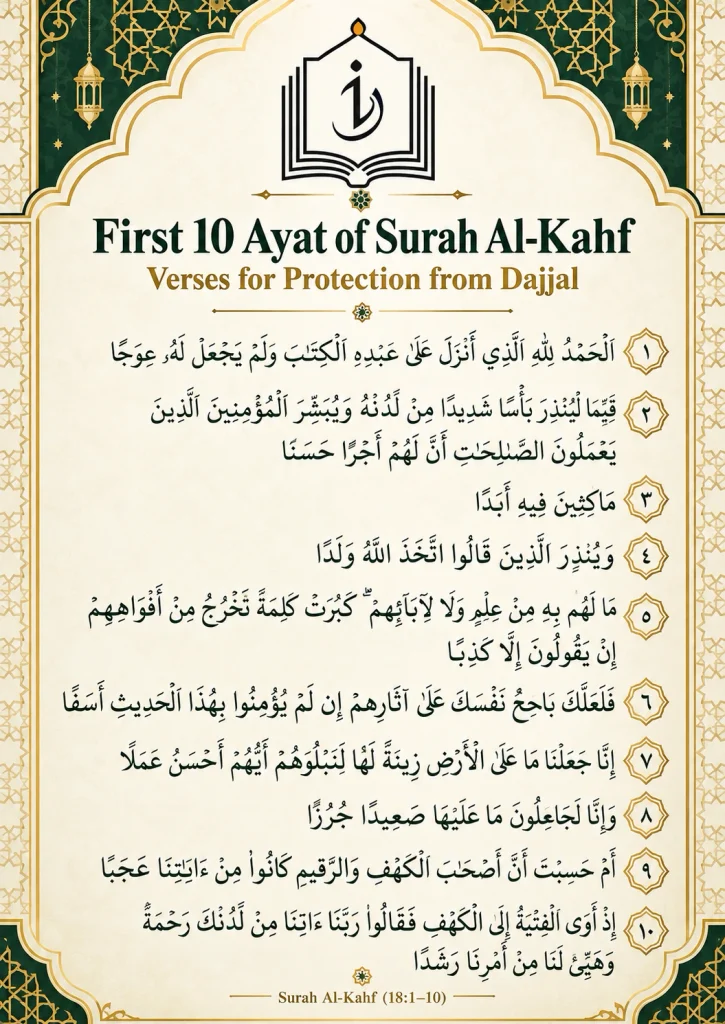
These represent two different recommendations:
For the Friday light virtue: Recite the complete Surah Al-Kahf.
For the Dajjal-related virtue: Memorize the first ten verses, as mentioned in Sahih Muslim 809a, while recognizing the alternative narration concerning the last ten verses.
Someone who cannot complete the entire chapter should still value whatever Quran they can recite.
Nevertheless, it is important not to promise the specific full-surah reward for a shorter passage without supporting evidence.
Can Surah Al-Kahf Be Read in Parts on Friday?
Yes. According to scholarly guidance, Surah Al-Kahf may be completed in separate portions during the recommended recitation period.
A person does not necessarily need to finish all 110 verses in one sitting.
For example, someone with a busy schedule might read:
- Verses 1–30 after Thursday’s Maghrib.
- Verses 31–60 after Friday’s Fajr.
- Verses 61–90 during a suitable break.
- Verses 91–110 before Friday’s Maghrib.
This is a practical schedule, not a prescribed religious division.
The arrangement makes the recitation easier for individuals managing employment, education, family responsibilities, or other commitments.
The essential objective is to complete the chapter sincerely within the recommended period.
Can You Listen to Surah Al-Kahf Instead of Reading It?
Listening to Quran recitation is a beneficial act of worship.
It can help Muslims improve pronunciation, understand the rhythm of Quranic Arabic, and reflect on divine revelation.
However, listening and personally reciting are not identical actions.
The Friday-specific hadith describes reading or reciting Surah Al-Kahf.
Therefore, listening alone should not automatically be presented as fulfilling the exact condition mentioned in the narration.
A person who is able to recite should make an effort to do so.
Those learning Arabic can follow along with a qualified reciter, repeat the verses, and gradually develop their reading ability.
Muslims facing personal limitations can seek guidance appropriate to their circumstances.
Four Major Lessons From Surah Al-Kahf
Understanding the main narratives of Surah Al-Kahf makes its weekly recitation more meaningful.
The Trial of Faith: People of the Cave
The young believers demonstrated courage when their religious convictions placed them under pressure.
Their story teaches that preserving faith sometimes requires sacrifice and perseverance.
It encourages Muslims to prioritize their relationship with Allah over temporary social approval.
The Trial of Wealth: The Two Gardens
The garden owner’s possessions led him toward arrogance and misplaced confidence.
His story reminds believers that worldly advantages are temporary.
Gratitude, generosity, and humility are more important than outward displays of success.
The Trial of Knowledge: Musa and Al-Khidr
This narrative emphasizes the limitations of human knowledge.
Even highly knowledgeable individuals must recognize that they do not understand everything.
The story encourages patience, intellectual humility, and respect for divine wisdom.
The Trial of Power: Dhul-Qarnayn
Dhul-Qarnayn demonstrates that authority should be used responsibly.
His actions highlight protection of communities, practical effort, and acknowledgment of Allah’s mercy.
These four narratives provide a useful framework for reflecting on common human challenges.
How to Make Surah Al-Kahf a Weekly Friday Habit
Developing consistency does not require a complicated routine.
Begin by selecting a convenient time between Thursday sunset and Friday sunset.
Keep a printed Mushaf or trusted Quran application readily available. Reading from a familiar source can make the practice easier to maintain.
If Arabic recitation is challenging, follow along with audio from a reliable reciter while improving pronunciation.
Consider reading a translation after completing each section to understand its meaning.
Families can also establish a weekly learning session in which children discuss one lesson from the surah.
Avoid turning the practice into a competition or judging others according to how quickly they complete it.
The aim is sincere worship, not social recognition.
Most importantly, connect the surah’s teachings to everyday behavior.
Its lessons should influence honesty, gratitude, patience, compassion, and responsible decision-making throughout the week.
Common Misconceptions About Surah Al-Kahf on Friday
Several statements about Surah Al-Kahf circulate online without adequate explanation.
Misconception 1: Reading Surah Al-Kahf guarantees wealth.
The authentic evidence discussed here does not promise automatic financial prosperity. The surah actually warns against arrogance caused by wealth.
Misconception 2: It must be read before Jumu’ah prayer.
There is no established restriction requiring completion before the congregational prayer. The commonly accepted period continues until Friday sunset.
Misconception 3: Its Friday benefits are mentioned in Sahih Bukhari.
The well-known Friday light narration is primarily referenced through collections such as Al-Hakim and Al-Bayhaqi. The ten-verse protection narration appears in Sahih Muslim.
Misconception 4: Reading any ten verses fulfills the full Friday recommendation.
The light narration concerns Surah Al-Kahf as a whole, whereas the Dajjal narration specifically mentions particular ten-verse passages.
Misconception 5: Missing one Friday is automatically sinful.
Reciting Surah Al-Kahf on Friday is recommended by many scholars, not established as a compulsory duty.
Understanding these distinctions helps Muslims practice their religion with knowledge rather than relying on exaggerated social media claims.
Frequently Asked Questions About Surah Al-Kahf on Friday
1. What are the benefits of reading Surah Al-Kahf on Friday?
The main Friday-specific benefit mentioned in hadith is receiving a special light between two Fridays. The surah also teaches faith, patience, humility, gratitude, and responsible leadership. A separate authentic hadith connects memorizing its opening ten verses with protection from Dajjal.
2. Is the Surah Al-Kahf Friday hadith authentic?
The narration about light between two Fridays has been graded hasan by Ibn Hajar and authenticated by Al-Albani, although scholars have discussed details of its transmission. Sahih Muslim 809a independently authenticates the narration about memorizing ten verses for protection from Dajjal.
3. Can I read Surah Al-Kahf on Thursday night?
Yes. The recommended recitation period commonly begins at sunset on Thursday. Thursday evening after Maghrib is considered the beginning of Friday night in the Islamic calendar.
4. Can women read Surah Al-Kahf on Friday?
Yes. The recommendation to recite Surah Al-Kahf is not restricted to men. Women may participate in this act of worship and benefit from studying its teachings.
5. How many verses are in Surah Al-Kahf?
Surah Al-Kahf contains 110 verses and is the 18th chapter of the Holy Quran.
6. Does Surah Al-Kahf protect against Dajjal?
Yes. Sahih Muslim 809a reports that memorizing the first ten verses provides protection from Dajjal. Another authentic wording mentions the last ten verses. This virtue is not limited to Fridays.
7. Can I read Surah Al-Kahf after Asr on Friday?
Yes. Reciting after Asr is within the commonly accepted recommended period, provided the recitation takes place before sunset.
8. Is it necessary to memorize the entire Surah Al-Kahf?
No. Memorizing the entire surah is not necessary for its Friday recitation. Muslims may read it from the Mushaf. The specific protection narration in Sahih Muslim concerns memorizing ten verses.
9. Does reading Surah Al-Kahf forgive sins between two Fridays?
A narration attributed to Ibn Umar mentions forgiveness between Fridays. However, this wording is distinct from the better-known light narration, and its evidence should be evaluated separately. It should not be presented as an undisputed guarantee without scholarly qualification.
10. What if I forget to read Surah Al-Kahf on Friday?
If you forget, you may continue your normal Quran recitation and resume the recommended Friday practice the following week. Missing this voluntary act should not be treated as automatically sinful.
Conclusion: Why Recite Surah Al-Kahf Every Friday?
The benefits of reciting Surah Al-Kahf on Friday extend beyond developing a weekly religious routine.
Hadith narrations accepted by numerous scholars describe a special light between two Fridays, while Sahih Muslim establishes the virtue of memorizing its opening verses for protection against Dajjal.
Equally important are the chapter’s timeless teachings about protecting faith, resisting materialism, seeking knowledge with humility, and using authority responsibly.
Reading the entire surah between Thursday sunset and Friday sunset is a meaningful way to maintain this recommended practice.
By combining recitation with understanding and sincere reflection, Muslims can make Surah Al-Kahf a valuable part of their weekly spiritual development.
Make every Friday an opportunity to reconnect with the Quran, strengthen your faith, and put its guidance into practice.
Authentic Islamic References
- Sahih Muslim 809a — Memorizing the first ten verses of Surah Al-Kahf and protection from Dajjal.
- Mishkat Al-Masabih 2175 — The Friday recitation and light between two Fridays.
- Al-Hakim, Al-Mustadrak, 2/399 — Narration concerning Friday recitation.
- Al-Bayhaqi, Al-Sunan Al-Kubra, 3/249 — Related Friday virtue narration; pagination varies by edition.
- Al-Darimi, Sunan Al-Darimi, traditionally cited as Hadith 3407 — Light associated with Friday-night recitation.
- Quran.com — Surah Al-Kahf — Complete chapter, Arabic text, translation, and recitation.
- IslamQA — When to Read Surah Al-Kahf on Friday — Scholarly discussion of the narrations and recommended recitation period.
- HadithAnswers — Authenticity of Surah Al-Kahf Recitation — Explanation of transmission differences and hadith grading.
Editorial note: Specific hadith rewards are distinguished from general lessons derived from the Quran. The Friday light narrations involve scholarly grading discussions, while the ten-verse protection narration is explicitly recorded in Sahih Muslim.