

The Iqrapath Namaz Course is for learning to pray correctly. The Salah is the second most significant aspect of Islam because praying is the primary duty of every Muslim. Thus, everyone should know how to pray according to its validity. This course guides you through every word and action that is relevant to each step in prayer — and why. By the end of this course, you will know for sure that you can pray well and with attention. This will help you feel stronger in your day-to-day life and stay connected to Allah سبحانه و تعالى.Join our Namaz Course to take a big spring and help your conviction in Allah grow and bloom.
Namaz
The daily prayer in Islam is known as Namaz (also called Salah). It makes Muslims closer to Allah and provides peace and Discipline.
What is Namaz?
Namaz means five prayer sets that Muslims have to perform every day. The prayers consist of specific movements and words that Muslims recite to praise Allah, seek guidance, and reflect on their day.
Why Do We Pray Namaz?
Muslims perform Namaz to contact Allah, request aid, and communicate their appreciation. It helps them remain grounded in their faith and not forget why they are here.
Importance of Namaz in Islam
Namaz is essential in Islam. It enables Muslims to devote themselves to Allah and implement His words and brings a feeling of calmness and power.
The Five Daily Prayers
Fajr (Morning Prayer)
Fajr is the first prayer we say before the sun rises. It helps us wake up with the recitation of Allah and feel full of positivity.
Dhuhr/Zuhr (Noon Prayer)
Then there is Dhuhr, prayed in the early afternoon after the sun passes its zenith. It is a time to refresh, reconnect with Allah, and recharge for the day.
Asr (Afternoon Prayer)
Asr is performed during late afternoons after the sun crosses its zenith (the high point ). You can refocus and ponder before the evening; it gives a feeling of staying attached to Allah even in our busy lives.
Maghrib (Evening Prayer)
Maghrib is the prayer after sunset; at that moment, the day is over. It is a time to thank Allah and ask for blessings for the evening.
Isha (Night Prayer)
Isha is the last prayer of the day, performed after sunset. It is where we seek protection from Allah at the end of the day and feel peaceful and content.
Course Structure
Namaz Timing (Times of the Prayer)
Fajr (الفجر): That is the dawn, which counts among the pre-sunrise prayers and thus takes place early in the morning.
Dhuhr (الظهر): After midday when the sun moves past its highest point.
Asr (العصر): Late afternoon, when shadows become long.
Maghrib (المغرب): Immediately following sunset, preceding darkness.
Isha (العشاء): When twilight disappears, until the middle of the night or before Fajr.
The Benefits of Namaz
Spiritual Benefits:
Encourages belief: Regularly praying connects you to god (الله).
Encourages Growth: Every prayer forces you to take a moment and pause, to be grateful for what you have, reflect on how far you come, and seek an apology.
Cultivates Discipline: Establishing a routine of praying redirects you toward what is good for your soul.
Physical and Mental Benefits:
Physical: Namaz movements may enhance health by improving flexibility and posture.
Psychological advantages: Namaz lowers stress and anxiety levels while improving memory, attention, and mindfulness. There are different parts to prayer; here is what we say in each:
Start (Takbir al-Ihram)
Qiyam:
Now, you should recite Bismillah before reading each one of the Surah.
Recite Surah Al-Fatiha and one short Surah or at least three verses.
Rukku
Praise Allah Again:
Rabbana Lakal Hamd
Prostration:
Tashahhud and then final remarks (Salam) Assalamu Alaikum Wa Rahmatullah
Common Mistakes in Namaz
1. Rushing Through the Prayer: Avoid hurrying. Perform each action slowly and with attention.
2. Incorrect Posture: Make sure to maintain the correct posture in each position, like keeping your back straight in Rukku and touching the ground properly in Sujud.
How to Fix Common Mistakes
1. Practice Mindfulness: Focus on each part of Namaz and understand the meaning of what you say and do.
2. Correct Posture: Keep your back level in Rukku and ensure you touch the ground properly in Sujud.
The Hanafi Method of Performing Salah in Detail
This guide explains the Hanafi method of Salah with step-by-step instructions, Arabic recitations, and post-Salah-recommended Adhkar.
1. Who is Obligated to Pray?
Salah is Fard (obligatory) on every:
Muslim – Only a Muslim is required to pray.
Sane Individual (Aaqil) – A person must be of sound mind.
Adult (Baligh) – Salah becomes compulsory upon reaching puberty.
Children should be encouraged to pray from age seven, and by age ten, they must be disciplined if they neglect it.
2. Conditions for Salah (Shara’it of Salah)
There are certain conditions that must be fulfilled before praying. If one of these conditions is absent, the prayer is invalid.
These conditions are as follows:
1. Purity (Taharah):
The body, dress, and site of prayer must be free of impurities. If someone is in a state of major impurity (Janabah), then he needs to perform Ghusl (ritual bath) before praying.
2. Wudu (Ablution):
Wudu is obligatory before offering any Salah. If wudu shall be broken, the prayer is not valid.
3. Covering the Body (Satr-e-Aurat)
Male: Should cover from umbilicus to knees.
Women: Covering from head to toe — except face, hands and feet.
4. Facing the Qiblah:
The prayer is performed facing the Kaaba or Makkah. If they do pray in the wrong direction by mistake, they must correct it as soon as they realize it.
5. Proper Timing
Each Salah has a fixed time; it must be prayed within that time.
If someone prays before or after the time, their Salah is not valid.
6. Intention (Niyyah)
The intention must be made in the heart for the specific prayer being performed.
7. Takbir-e-Tahreema
- Saying “Allahu Akbar” to start the prayer.
- Once this is said, a person cannot talk, eat, drink, or do anything unrelated to Salah until they complete it.
3. Obligatory Acts of Salah (Faraaidh of Salah)
The following acts are Fardh (obligatory) in Salah. If any of them are left out intentionally or accidentally, Salah has a disability.
1. Takbeer-e-Tahreema (First Takbir)
Saying “Allahu Akbar” at the start of the prayer.
The hands should be raised:
✔ Men: Raise hands to the ears. ✔ Women: Raise hands to the shoulders.
2. Qiyam (Standing Position)
Those who are able to stand must stand in Fardh Salah.
If due to health reasons someone cannot stand, he/she can pray sitting/lying down.
3-Surah Al-Fatiha needs to be read in every Rak’ah.
There is no other Surah or verse/s of the Quran to be read after Surah Al-Fatiha in Fardh Salah in the last two Rak’ahs.
4. Ruku (Bowing Position)
This is how a person has to bend down until their hands are on their knees.
While in Ruku, say:
(“Subhana Rabbiyal Azeem — Glory be to my Lord, the Most Great.”)
5.Sujood (Prostration)
There are two sujoods (prostration) a person has to do in every Rak’ah.
In Sujood, the forehead, nose, palms, knees, and toes must make contact with the ground.
While in Sujood, say:
سُبْحَانَ رَبِّيَ الْأَعْلَى (Three times)
(Subhana Rabbiyal A’la — Glory be to my Lord, the Most High.)
6.Qa’dah Akhirah (Final Sitting)
The person on the last Rak’ah has to sit for the duration of saying Tashahhud:
(َ——–اتَّحِيَّاتُ لِلَّهِ وَالصَّلَوَاتُ وَالطَّيِّبَاتُ)
Read any Masoorah Dua.
Recite a Dua-e-Masoorah after Durood-e-Ibrahimi. One recommended dua is:
اللَّهُمَّ رَبِّ اجْعَلْنِي مُقِيمَ الصَّلَاةِ وَمِنْ ذُرِّيَّتِي رَبَّنَا وَتَقَبَّلْ دُعَاءِ رَبَّنَا اغْفِرْ لِي وَلِوَالِدَيَّ وَلِلْمُؤْمِنِينَ يَوْمَ يَقُومُ الْحِسَابُ
O Allah, make me an establisher of prayer, and [many] from my descendants. Our Lord, and accept my supplication. Indeed, my Lord is Forgiving and Accepting of Repentance (Ibrahim:40-41)
7. Salam (Ending the Prayer)
Greetings to the right side: “Assalamu Alaikum wa Rahmatullah.”
After this, Tashahud turns to the left side and says, “Assalamu Alaikum wa Rahmatullah.
Namaz for Special Occasions
Jumu’ah Prayer
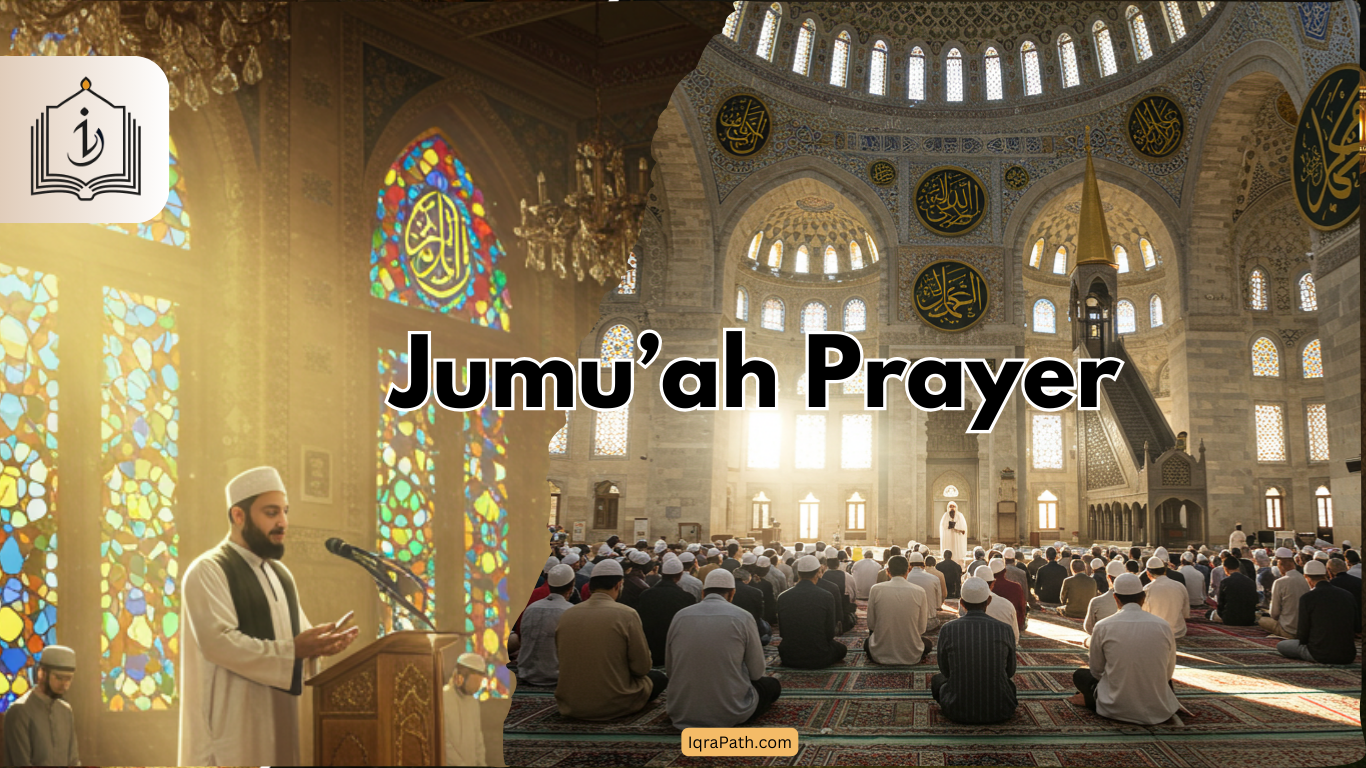
Jumu’ah has a guided prayer on Fridays (الجمعة).
Sometimes performed just after the sermon (Khutbah) (الخطبة), around midday on Fridays, and before Asr.
Eid Prayers :

Tarawih During the month of Ramadan:
- Special prayers performed at night after Isha during Ramadan.
- Practice that serves the purpose of increasing our understanding of the Quran.
Namaz for Kids

Why Should Kids Learn Namaz Course?
Developing a connection with Allah: Performing Namaz helps in building or developing relations between children and Allah (الله).
Prayer is good for Regularity and Discipline: Prayer helps you develop a sense of Timing.
Feel Part of Larger Muslim Community: Namaz gives children a sense of community and makes them feel part of the remaining Muslim community.
Simple Guides for Children Prayer Activities
Introduce the Concept of Namaz from a Young Age: You should start when your kid reaches a certain age and then introduce him to the concept of Namaz; instead, you can start when he is five or something. Visual Aids: Pictures or charts can be made to show the position and phrases in Namaz.
Practice Patience: do not be harsh on children when they are learning.
Join IqraPath’s Namaz Course to learn the correct way to perform Salah with proper understanding. Perfect your prayer with expert guidance. Enroll now and enhance your worship today!
Don’t miss out! Claim your free trial of this course now. Click here to get enrolled!